About Colombia.
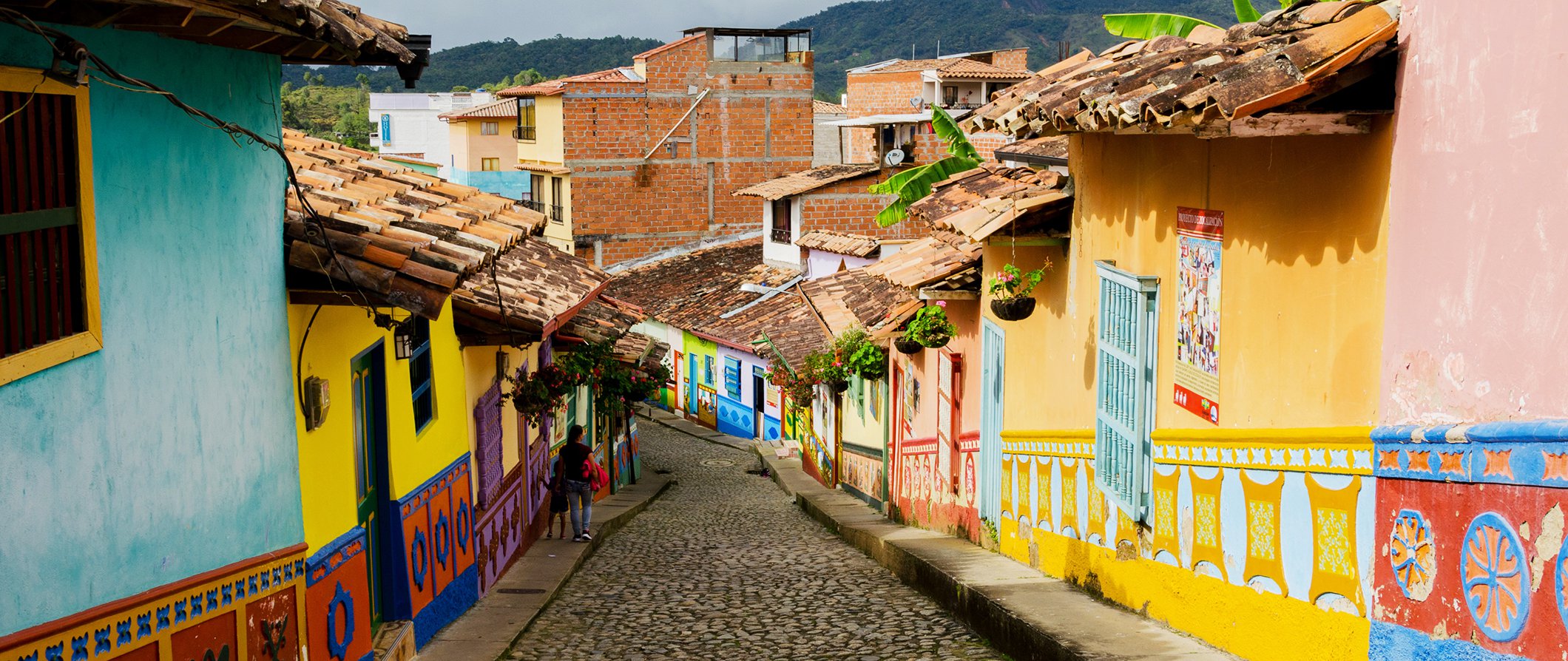
About Colombia
Colombia’s very name comes from Italian explorer Christopher Columbus, who never actually set foot in that country during his voyages to the Americas. However, one of Columbus’ companions from his second trip, Alonso de Ojeda, was the first European to have done so (in 1499). The gold ornaments that he saw among the local indigenous population, as well as the myth of a gold-laden kingdom deep in the interior (El Dorado) triggered the eventual Spanish conquest of that country.
The first major Spanish settlement was Cartagena (established in 1533), which became Colombia’s main center of trade (from commodities to slaves). Spanish conquistador Jiménez de Quesada founded the town of Santa Fe de Bogotá (now known simply as Bogotá, the country’s capital) in 1538. By 1550, King Carlos V of Spain established a court of justice in Bogotá – bringing that colony under the control of the Viceroyalty of Perú. From that time into the early 19th century, the Spanish royal authorities had set up & maintained plantations and mining operations, as well as taxed the locals. Also, by 1717, with the Spanish empire extending from North America to Argentina, Bogotá became the capital of a new viceroyalty: Nueva Granada (consisting of Colombia, Panama, Ecuador, and Venezuela).
After Napoleon’s conquest of Spain, he installed his brother into the Spanish throne in 1808. This kicked off pro-independence efforts in Colombia and other Latin American colonies – eventually headed by Simón Bolívar, who won battles against Spanish forces in 1812. After a series of ups and downs, Bolívar would win independence for Colombia in 1819 (with the establishment of “Gran Colombia” – consisting of Venezuela, Panama, Ecuador, and Colombia). Still, the vastness of “Gran Colombia” precluded its longevity, due to the impracticality of ruling over such a large territory. As a result, by 1830, the country was broken up into three separate countries (interestingly, Panama was still part of Colombia at the time).
While Colombia was a parliamentary democracy, it still went through political turmoil during much of the 19th century (enduring at least 8 civil wars). By the turn of the 20th century, the U.S. took advantage of the Thousand Days War that was raging in Colombia, and successfully sponsored a secessionist movement that resulted in Panama becoming independent in 1903. By then the U.S. gained control over a project to build the Panama Canal, which was completed in 1914 (with the Americans controlling it and nearby lands until 1999 – when the Panamanian government assumed its sovereignty and management over it).
The next historically significant event in Colombia was another wave of political turmoil that engulfed the country. Known as “La Violencia”, the local political parties (Liberals and Conservatives) waged civil conflict from the late 1940s to the late 1950s. Due to a legacy of an oligarchy that goes back to the colonial era (that includes poor land distribution), as well as the presence of a poverty-stricken indigenous & mestizo population, such political violence would give rise to a number of leftist-oriented rebel groups that operated mainly in Colombia’s rural areas, including FARC (Fuerzas Revolucionarias de Colombia), M-19 (Movimiento 19 de Abril), and ELN (Ejercito de la Liberacion Nacional).
During the height of Colombia’s notorious narcotics trade in the 1980s (which saw the rise of drug lords like Pablo Escobar and Carlos Lehder), such rebels would fight against right-wing paramilitary groups for control of the country’s drug-producing regions. With the end of the Cold War in the early 1990s, these rebel groups also got more heavily involved with the drug trade (for fund-raising purposes). The arrival of conservative Colombian politician Álvaro Uribe into the country’s presidency during the early 2000s resulted in the central government successfully pushing back guerrilla activities in the country – bringing much-needed stability in Colombia. Uribe’s policies also gained credibility with signing and implementation of the U.S. Colombia Free Trade Agreement (FTA) in 2012 (Colombian exports to USA accounting for $17 billion – with 57% of the country’s exports to USA benefiting from the FTA). That agreement was also considered a reward for the government’s long-standing campaign to combat the drug trade (including DEA efforts to eradicate the production of cocaine within that country).
Nowadays, Colombia has recovered from these turbulent times, and has gradually earned credibility as an emerging South American economy. Colombia has a wide diversity in natural landscapes (from the snow-capped Andean regions, to the jungles of its Amazon region, to the tropical coastal areas such as Cartagena). As a result, Colombia has been getting noticed by international tourists in recent years (such as travelers from USA, EU countries like Spain and neighboring Latin countries). Tourism was 5.3% of Colombia’s GDP in 2012 (generating $21.2 billion in revenue) and is expected to grow with the awareness of destinations such as Cartagena on the Caribbean coast, and positive publicity of inland destinations such as Medellin and Bogotá. Even famed American travel journalist Anthony Bourdain has produced TV shows for CNN and The Travel Channel in recent times about such destinations.